

Summary
- A football neck roll is designed to limit how far the head moves backward or sideways, with the goal of reducing stingers and burners (brachial plexus stretch injuries).
- Peer-reviewed biomechanics research, including a study in PubMed, has observed that collars reduce cervical hyperextension but do not meaningfully reduce lateral flexion, the more common cause of stingers.
- Neck rolls do not address brain movement inside the skull. They are not designed for brain protection, and no peer-reviewed research has reported them as a brain-protection device.
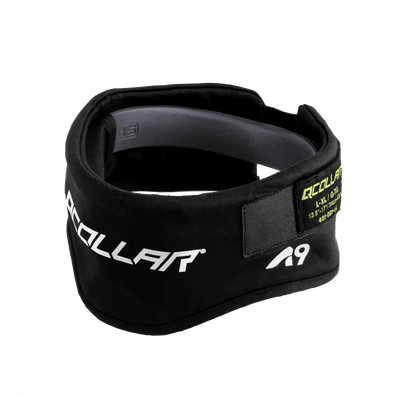
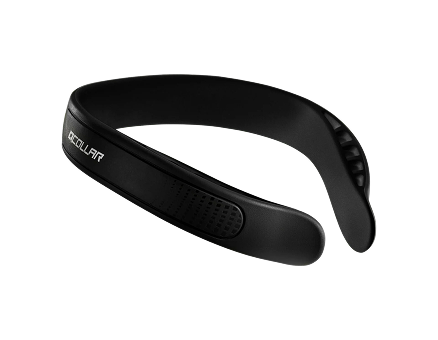
- The Q-Collar is an FDA-cleared Class II medical device that works through an entirely different mechanism: light pressure on the jugular veins increases blood volume inside the skull, helping to reduce the brain's movement during impacts.
- Neck rolls and the Q-Collar protect different anatomy and can be worn together with no interference. Stinger-prone players concerned about both neck and brain protection have a layered option. The American Academy of Orthopaedic Surgeons describes neck rolls as one of several measures that "may provide additional stability" for athletes prone to burners.
Jump to a Section
- At a Glance: What Each Product Actually Does
- What a Neck Roll Actually Is
- What a Neck Roll Is Designed to Prevent: Stingers and Burners
- What the Research Actually Says About Neck Rolls
- What the Q-Collar Is, and What It Targets
- When Would a Player Wear One, the Other, or Both?
- The Bottom Line for Parents and Coaches
- Frequently Asked Questions
If you have watched football in the last forty years, you have probably seen a player with a thick foam pad behind his helmet. And if you have followed pro football in the last few years, you may have noticed a thin band around the necks of players in football, hockey, lacrosse, and soccer. The two pieces of equipment look related, they both involve the neck, and parents asking "should my player wear a neck roll or a Q-Collar?" are asking a fair question.
The honest answer is that they do different things. A neck roll is designed to limit the motion of the neck. The Q-Collar is designed to help reduce the movement of the brain inside the skull. Different problem, different mechanism, different anatomy. This guide walks through what each product actually does, what the published research has reported, and how a parent or coach should think about both.
At a Glance: What Each Product Actually Does
Before getting into the detail on either product, here is the short answer in one table.
| Dimension | Football Neck Roll | Q-Collar
|
|---|---|---|
| What it protects | The neck (cervical spine, brachial plexus nerves) | The brain (inside the skull) |
| How it works | Foam padding physically restricts how far the head can move backward | Light pressure on the jugular veins slightly increases blood volume inside the skull, helping reduce brain movement during impacts |
| Injury it targets | Stingers and burners (brachial plexus stretch or pinch) | The effects of repetitive sub-concussive head impacts |
| Where it sits on the body | Behind the helmet, attached to the top of the shoulder pads | Around the base of the neck, over the jugular veins |
| Regulatory status | Sports equipment | FDA-cleared Class II medical device |
| Evidence base | Limited biomechanics studies; AAOS describes neck rolls as a measure that "may help" stinger-prone athletes | 25+ peer-reviewed studies, 50,000+ collars in play across pro, college, and youth sports, FDA pivotal trials |
| Designed for | Players with a history of stingers, especially linemen and linebackers | Athletes playing contact and collision sports |
The single most important row in that table is the first one. A neck roll is a neck-protection product. The Q-Collar is a brain-protection product. The mistake to avoid is assuming either piece of equipment does what the other does. A neck roll will not reduce the brain's movement inside the skull, and the Q-Collar is not designed to prevent stingers. The rest of this guide walks through each one in depth so you know exactly what you are looking at.
What a Neck Roll Actually Is
A football neck roll is a foam pad that attaches to the top of a player's shoulder pads and sits behind the helmet, wrapping around the back and sides of the neck. Two main versions have dominated the category for decades.
The earlier design, popularized in the 1970s and 1980s, was the Adams Roll: a U-shaped vinyl coil filled with foam that ran around the back of the neck. Players like Howie Long, Eric Dickerson, and Jack Lambert wore them, and the look became visually synonymous with linebackers and defensive linemen of that era.
The Adams Roll had an unintended problem. Because the tubular shape was tall, it could actually lever the head forward and place additional stretch on the neck during certain impacts. In the early 1990s, Jeff Fair, the longtime athletic trainer at Oklahoma State, designed a replacement: the Cowboy Collar. It was a curved, low-profile polystyrene foam pad that supported the back of the head without raising it. Fullback Daryl Johnston of Dallas helped popularize it, and for the next two decades the Cowboy Collar was the dominant neck-protection option in football.
Modern usage has dropped sharply. As offenses have stretched the field horizontally and emphasized speed over straight-ahead collisions, fewer pro players wear visible neck protection. McDavid, the manufacturer of the Cowboy Collar, has indicated that the product is being phased out as inventory runs down. Neck rolls remain common in youth and high school football among players who have a history of stingers, but the equipment is closer to a category-specific accessory than the universal piece of gear it once was.
What a Neck Roll Is Designed to Prevent: Stingers and Burners
The injury a neck roll targets is the stinger, also called a burner. The two words describe the same thing: a brief but intense burning, tingling, or numbness that shoots down one arm after a hit, sometimes accompanied by temporary weakness in the shoulder or hand.
The underlying anatomy is the brachial plexus, the network of nerves that runs from the cervical spine through the shoulder and into the arm. A stinger happens when those nerves are either stretched or pinched, usually because the head is forced sharply away from one shoulder or pushed down and sideways during contact. According to the American Academy of Orthopaedic Surgeons, the injury most commonly occurs during tackling or blocking, and up to half of all college football players have experienced at least one stinger, with many of those occurring during high school football.
Symptoms are usually brief: most stingers resolve within minutes, although weakness or pain can linger for days. The injury is rarely structurally serious, but repeated stingers in the same athlete can be a warning sign for cervical-spine issues that deserve a sports-medicine workup before a return to play.
The mechanical logic behind a neck roll is straightforward. If a hit forces the head into a position that stretches the brachial plexus, padding behind the helmet can physically limit how far the head can move into that position. Less extreme motion in theory means less stretch on the nerves.
What the Research Actually Says About Neck Rolls
The biomechanics evidence base for neck rolls is small. The most-cited study is Hovis and Limbird (2003), published on PubMed, which tested three different cervical collars (a foam neck roll, a Cowboy Collar, and an A-Force collar) on fifteen NCAA Division I varsity football athletes. Researchers measured how much each collar restricted cervical hyperextension (head moving backward) and lateral flexion (head moving sideways), both passively and actively.
The findings, paraphrased from the published abstract:
- All three collars reduced hyperextension compared to wearing helmet and shoulder pads alone.
- The Cowboy Collar reduced hyperextension more than the foam neck roll did.
- No collar reduced passive lateral flexion. The foam roll restricted active lateral flexion, but the authors flagged that this could limit a player's voluntary head movement without protecting against the involuntary lateral force that actually causes most stingers.
That last point matters. The same research has observed that lateral flexion, not hyperextension, is the more common cause of stingers in the scholastic football population. A device that limits hyperextension but not lateral flexion is, by design, addressing the less common injury mechanism.
A broader review on PubMed Central of cervical collars and braces in athletic brachial plexus injury reached a similar conclusion: there has been very little documented study into the ability of cervical collars and neck rolls to prevent excessive cervical motion or actual injury in athletes. The category has been around for decades, but the published clinical evidence base remains thin.
None of this makes neck rolls useless. For a player with a history of stingers, the AAOS specifically describes neck rolls and cowboy collars as one of several measures that "may provide additional stability." The honest framing is that neck rolls are a targeted accessory for a specific cervical-spine concern, not a piece of equipment with broad protective benefits, and not a brain-protection device.
What the Q-Collar Is, and What It Targets
The Q-Collar is a different category of product. It is an FDA-cleared Class II medical device for athletes playing contact sports, cleared in February 2021 through the FDA's De Novo pathway. Where a neck roll targets the cervical spine and the nerves running through it, the Q-Collar targets the brain inside the skull.
The mechanism is mechanical and well documented on the Q30 science page. The Q-Collar applies light, comfortable pressure to the internal jugular veins on the sides of the neck. That pressure partially restricts venous return out of the head, which slightly increases blood volume inside the skull. With more fluid present in the cavity, the brain fits more snugly within it. When the head takes a hit, there is less internal space for the brain to slosh against the inside of the skull. That sloshing motion, often called brain slosh, is the mechanism associated with both acute concussions and the cumulative effects of repetitive sub-concussive head impacts that accumulate across a season of play.
The Q-Collar does not restrict blood flow through the carotid arteries, does not restrict breathing, and clinical studies have reported no negative effects on athletic performance. It is worn around the neck under the helmet and over the shoulder pads in football, and it is designed to work alongside existing protective equipment, never as a replacement for any of it.
The research base behind the device is the reason FDA cleared it. Built on more than ten years of independent research from institutions including Cincinnati Children's Hospital and other major centers, the Q-Collar is now trusted by thousands of athletes across impact sports. A 2016 study in the British Journal of Sports Medicine involving 42 high school football players observed that collar-wearing athletes showed no significant white-matter changes on DTI brain imaging across a season, while the control group showed measurable changes despite similar head-impact exposure. A separate UHN mechanism study published in the same journal confirmed that jugular vein compression increases intracranial volume, with optic nerve sheath diameter increasing from 4.6mm to 4.9mm under collar pressure.
The framing here is important. The Q-Collar is FDA-cleared as a device "designed to help protect the brain from the effects of repetitive sub-concussive head impacts." The research describes what the device does, not what it guarantees, which is the appropriate posture for any piece of protective equipment.
When Would a Player Wear One, the Other, or Both?
Because the two products protect different anatomy, the decision is not actually a choice between them. It is a question of which problems a player is trying to address.
A player with a history of stingers may benefit from a neck roll or Cowboy Collar as part of a broader plan that also includes proper tackling technique, neck-strengthening exercises, and a sports-medicine evaluation if stingers are recurring. The AAOS, CDC HEADS UP, and the American Academy of Pediatrics all emphasize that primary stinger prevention starts with technique and conditioning, with equipment as a supporting layer.
A player concerned about cumulative head impacts, the kind that accumulate across a season of contact regardless of whether any single hit registers as a concussion, may consider the Q-Collar as an additional layer of protection alongside a well-fitted helmet and properly sized shoulder pads.
A player who has both concerns can wear both pieces of equipment together. They do not interfere with one another. A neck roll sits behind the helmet on top of the shoulder pads; the Q-Collar sits around the base of the neck against the jugular veins. Different anatomy, different geography on the body, different injuries addressed. There is no reason a stinger-prone player who also wants brain-protection support has to pick one.
What no player should do is treat a neck roll as brain protection or treat the Q-Collar as cervical-spine protection. Each product does what it is designed to do, and is not a substitute for the other.
The Bottom Line for Parents and Coaches
The neck roll and the Q-Collar look similar from a distance because they both involve the neck. They are not similar products. A neck roll is a foam pad targeting cervical motion. The Q-Collar is an FDA-cleared medical device targeting brain movement.
The decision framework for a youth or high school football family is straightforward:
- If your player gets stingers, talk to the team's athletic trainer about whether a neck roll or Cowboy Collar fits the plan, and whether neck-strengthening work and a technique review should come with it.
- If your concern is the cumulative head-impact load that builds across a season of football, the Q-Collar is a different and more research-backed conversation. Have it with your athletic trainer or sports-medicine provider.
- If your concern is both, recognize that one product does not do the other's job. They can coexist.
For families researching the brain-protection side of the equation, the Q-Collar product page covers pricing, sizing, and the full feature set, and the deeper sport-specific research is gathered on the Q-Collar in football page.
FOR ATHLETES
Q-Collar
The first and only FDA-cleared device designed to help protect the brain from the effects of repetitive sub-concussive head impacts in sports.
$199.00
Buy NowFrequently Asked Questions
Does the Q-Collar prevent concussions?
The Q-Collar is FDA-cleared to help protect the brain from the effects of repetitive sub-concussive head impacts. The FDA states that "data do not demonstrate that the device can prevent concussion or serious brain injury." The Q-Collar is designed as an additional layer of protection to be used alongside helmets and other sport-appropriate protective equipment, not as a replacement for any existing gear.
Does a neck roll prevent concussions?
No. Neck rolls are designed to limit cervical hyperextension and may help reduce stingers and burners, which are nerve injuries to the brachial plexus. They are not designed to prevent concussions, and no peer-reviewed research has reported them as a brain-protection device.
Can a player wear a neck roll and a Q-Collar at the same time?
Yes. The two products protect different anatomy and sit in different positions on the body. A neck roll attaches behind the helmet on top of the shoulder pads, while the Q-Collar sits around the base of the neck over the jugular veins. They do not interfere with each other.
What is a stinger or burner?
A stinger, also called a burner, is a brief brachial plexus injury that causes burning, tingling, or numbness shooting down one arm after a hit. According to the American Academy of Orthopaedic Surgeons, up to half of college football players experience at least one stinger, and many of those occur during high school football. Most resolve within minutes.
Are neck rolls still legal in football?
Neck rolls are permitted equipment in NCAA and high school football, subject to standard equipment rules. Specific high school requirements vary by state athletic association, so families should check their state's equipment rules. Usage has declined sharply at the pro level over the past decade, but the equipment itself remains widely available.
How do I know what size Q-Collar to order?
Q-Collar sizing is numeric, from 11 to 18, based on neck circumference in inches. Measure with a soft tape at mid-neck, pull snug with zero slack, take three measurements, and use the smallest. If between sizes, choose the smaller of the two. Full sizing guidance is on the product page.
Where can I buy a Q-Collar?
The Q-Collar is available directly at q30.com and at retail locations across the country. The store locator lists current retail availability.