

If you've been shopping for a new football helmet in the last few seasons, the Schutt F7 has almost certainly come up. It's one of the most technically sophisticated helmets on the market, consistently earns top marks in the Virginia Tech Helmet Ratings, and is worn from youth through NFL levels.
This review takes a comprehensive look at what the F7 actually is, what each variant in the lineup is built for, and how it fits into a broader approach to brain safety, including where the Q-Collar adds a complementary layer on top of the helmet itself.
The goal here isn't to tell you whether the F7 is the "best" helmet, that depends on your budget, your sport, your position, and your fit. The goal is to explain what the technology actually does so you can make an informed decision, and to be honest about the protection gap no helmet alone can close.
What the Schutt F7 Actually Is
The F7 is a family of helmets built around a shared technology philosophy: manage impact forces using engineered plates and TPU cushioning rather than relying on traditional foam alone. The helmets in the lineup share the same underlying architecture but differ in shell construction, facemask, liner system, and price point.
Schutt's positioning of the F7 leans heavily on one claim: that the helmet is specifically engineered to manage rotational forces, not just the linear forces that most helmets have historically been designed around. This matters because a significant body of concussion research has identified rotational acceleration, the brain twisting inside the skull, as a key mechanism of injury, not just the straight-line deceleration a traditional helmet is built to absorb.
The Technology Stack, Explained
TPU Cushioning
TPU stands for thermoplastic polyurethane. It's the material Schutt uses in place of traditional foam in the F7's interior impact layer. The advantage Schutt claims, and the one that has been broadly corroborated in independent lab testing, is that TPU maintains its impact-absorbing performance across a wider temperature range than traditional foams, which can stiffen in cold weather and soften in heat. For athletes who play in every condition from August two-a-days to late-November playoff games in freezing rain, that consistency matters.
Tektonic Plate System (3DM)
The Tektonic Plate System is the F7's signature rotational-force feature. Strategically placed plates on the interior and exterior of the helmet are engineered to move independently, a small amount, when the helmet takes a hit. That movement is designed to absorb some of the rotational energy that would otherwise be transferred directly to the athlete's head. On the top of the newer F7 models, this shows up as the "Tektonic Mohawk" reactionary impact-reduction system.
RFLX-S Impact Layer
The internal RFLX-S layer is an additional impact-absorbing layer designed to work in concert with the Tektonic plates and the TPU cushioning. Schutt describes it as a layer that "absorbs and deflects" impact forces before they reach the head. In practical terms, it's part of the multi-layer energy management system that defines the F7.
OCTO-Fit and AiR-Lock
Fit is one of the under-discussed variables in helmet safety. A helmet that doesn't fit well doesn't protect well, and getting fit right in a traditional helmet often means a coach, a pump, and a lot of trial and error. The F7's OCTO-Fit system uses interchangeable dual-density ergonomic pods to dial in fit, and the onboard AiR-Lock system lets an athlete adjust fit on the fly without a handheld pump. For growing youth athletes and for players moving between practice and game gear, that's a meaningful ergonomic improvement.
D30 Dampening (F7 2.0)
The F7 2.0 line integrates D30, a rate-sensitive dampening material used in motorsports and military applications. D30 has an unusual property: it stays soft and pliable at rest, but stiffens almost instantly when subjected to a high-rate impact. The practical upshot is that the helmet feels comfortable during normal wear but firms up exactly when the athlete needs more protection.
The Full F7 Lineup in 2026
Schutt has built out the F7 platform into a full family of helmets spanning price points and age levels. The full F7 Pro / F7 Air collection is worth browsing if you're serious about a purchase. Here's a quick orientation:
F7 Pro
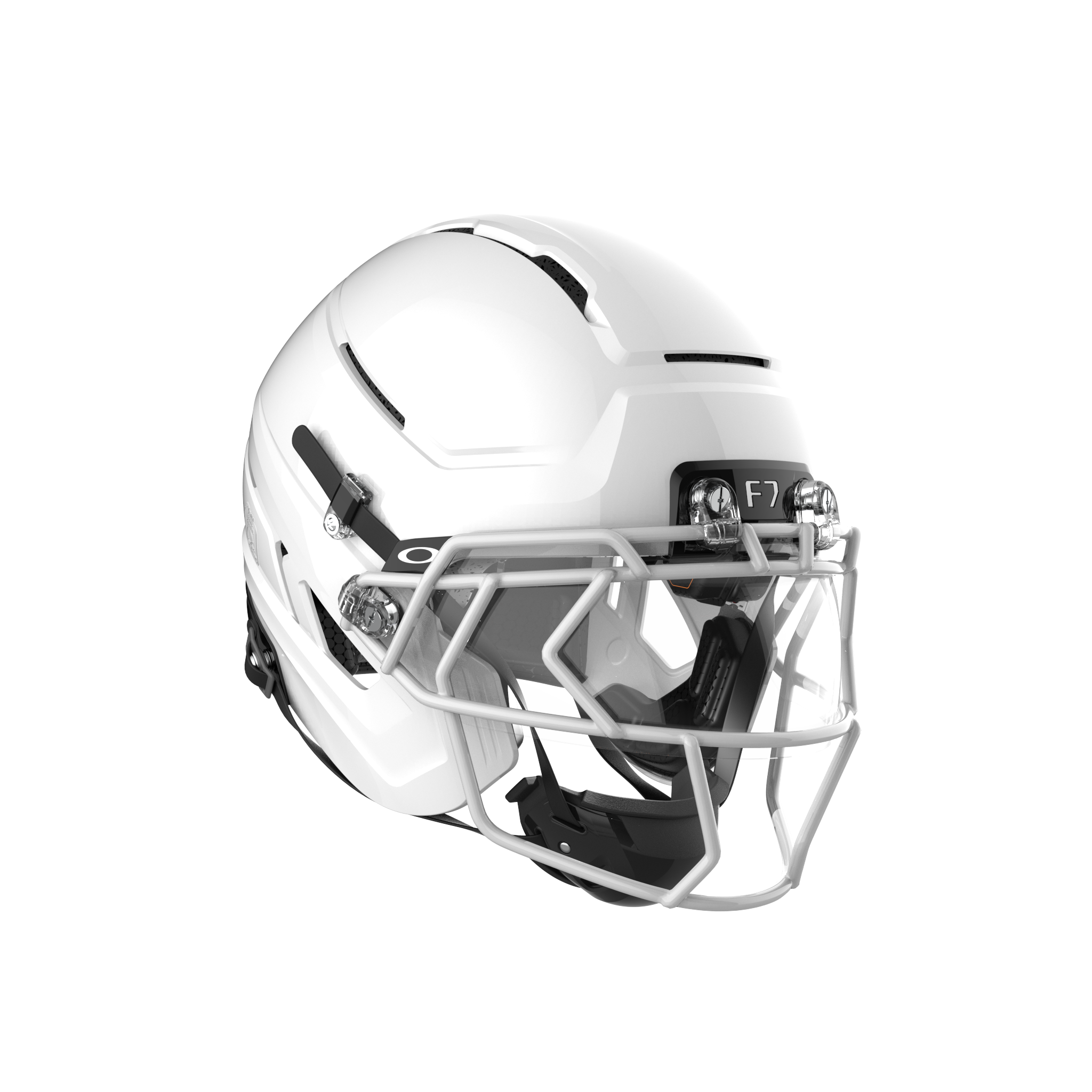
The flagship. Features a 3D-printed lattice interior structure, a titanium facemask (roughly 60% lighter than carbon steel), the full OCTO-Fit + AiR-Lock system, Tektonic Mohawk, an automotive-inspired rear diffuser for a lower helmet positioning, and even a Clear Switch Visor by Oakley. Price is at the top of the market (approximately $1,499). Weight is around 1,678 grams. Sizes M/L/XL. This is the tier of helmet you see on NFL practice fields.
F7 2.0 (Professional / Collegiate)
The predecessor and current workhorse. Notably earned a 5-star Virginia Tech rating with a performance score of 1.35, significantly better than the 2025 average-rated helmet score of 4.64 (lower is better in the VT system). Integrates TPU cushioning, the Tektonic 3DM plate system, Surefit AiR liner, and D30 rate-sensitive dampening. Titanium facemask available on the Professional variant.
F7 Air (Varsity / Youth)

A more accessible entry to the F7 platform. Retains the core AiR-Lock system with full-wrap coverage, Tektonic Mohawk, RFLX-S impact layer, and TPU cushioning. Ships with a carbon steel facemask (heavier than the Pro's titanium but more durable for the price). Youth sizing starts at 2XS for younger players. Also earns a 5-star Virginia Tech rating in its current generation.
F7 LX1 (Youth)

Built specifically for youth football players. Retains the F7 architecture, Tektonic plates, TPU cushioning, adjustable fit system, in a shell and weight appropriate for younger athletes. A strong option for youth leagues that want to equip players with the newer rotational-force management technology without the full varsity price tag.
F7 VTD / VTD 2.0
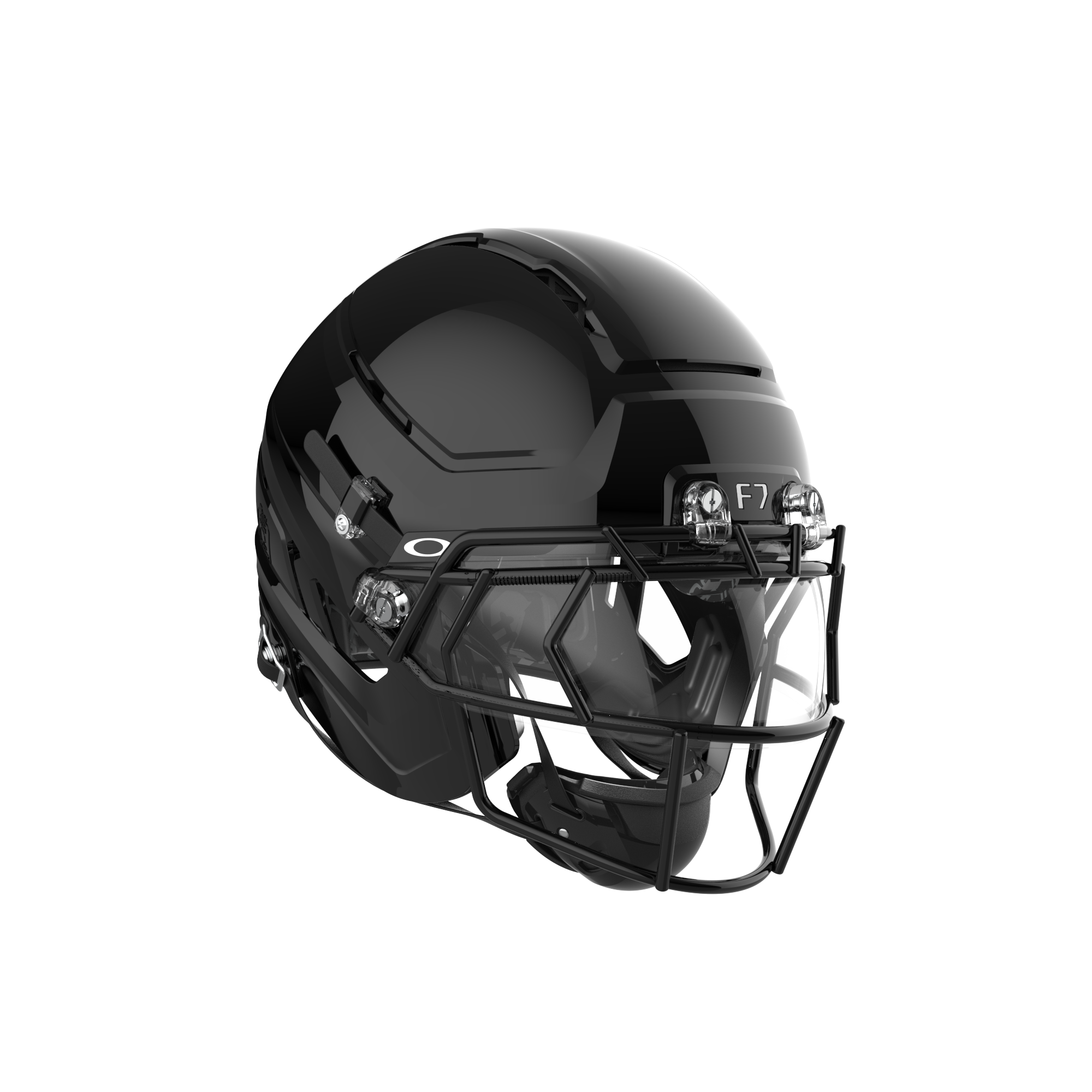
The original F7 that established the platform. Still widely in use, still 5-star rated, still in production. If you find one used or at a discount, it's the same underlying technology, just without the newest generation refinements.
What the Virginia Tech Ratings Actually Mean
Every conversation about modern football helmets eventually comes to the Virginia Tech STAR rating system. The STAR (Summation of Tests for the Analysis of Risk) rating is a published independent laboratory assessment of helmet performance across a standardized set of impact tests. Lower scores are better. A 5-star rating is reserved for helmets that significantly outperform the average.
The F7 2.0 and F7 Air currently hold 5-star ratings. That's a meaningful data point, but it's worth understanding what the VT rating actually measures and what it doesn't.
What it measures: lab-reproducible impact performance on a Hybrid III headform at a range of impact locations, velocities, and angles. It's a standardized test that allows direct comparison across dozens of helmets on the market.
What it doesn't measure: real-world variation in fit, the specific biomechanics of contact in games and practices, the cumulative load of sub-concussive impacts across a season, or the internal movement of the brain inside the skull that research on repetitive head impacts has identified as a key mechanism of sub-clinical brain changes.
The VT rating is a useful filter. A 5-star helmet is categorically better in lab-controlled impact testing than a 1-star or 2-star helmet. But a 5-star rating is not a guarantee of brain safety, and it was never designed to be one.
Who Should Wear the F7
The F7 is a strong fit for athletes who want the newer generation of rotational-force management technology in their helmet and are willing to invest in it. A few scenarios where the F7 stands out:
- Linemen, position-specific impact exposure research (including the Broglio et al. Journal of Neurotrauma study on 95 high school players) has shown that linemen absorb the highest cumulative head impact burden of any position. Equipment with stronger rotational-force management is particularly valuable for them.
- Youth players, the F7 LX1 and F7 Air Youth bring the same underlying technology platform to younger athletes at an accessible price point. Given that JAMA Pediatrics research has emphasized the importance of exposure management during developmental windows, equipping youth players well matters.
- Varsity / college athletes, the F7 2.0 and F7 Pro are common choices at the varsity and college level, where the investment in a top-tier helmet is more straightforward to justify.
- Athletes in multi-condition environments, the TPU cushioning holds up across temperature extremes better than traditional foam. If you play late fall and early winter football in cold climates, that's meaningful.
The Protection Gap That No Helmet Alone Can Close
Here's a reality the helmet manufacturers themselves are increasingly transparent about: a helmet, any helmet, including the F7, is engineered to manage the forces acting on the outside of the skull. Shell deformation, skull fractures, and linear acceleration are all mitigated by helmet technology.
What a helmet cannot do is eliminate the movement of the brain inside the skull. When a player takes a hit, the skull decelerates but the brain, suspended in cerebrospinal fluid, continues to move before it catches up to the skull. That internal movement is a key mechanism in both acute concussion and the sub-concussive impacts that Boston University CTE Center and British Journal of Sports Medicine research has tied to longer-term brain changes.
This is not a failing of the F7 or any other helmet. It's a physics problem that sits outside what shell-and-liner engineering is built to address. Helmets work. They are necessary. But they have a bounded role.
Pairing the F7 with the Q-Collar: A Layered Approach
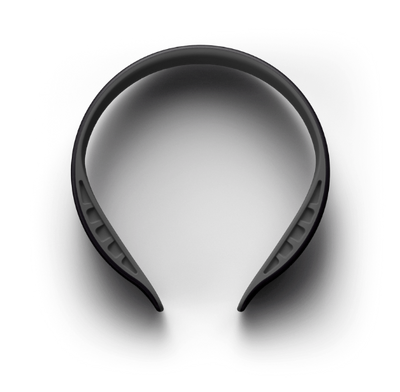
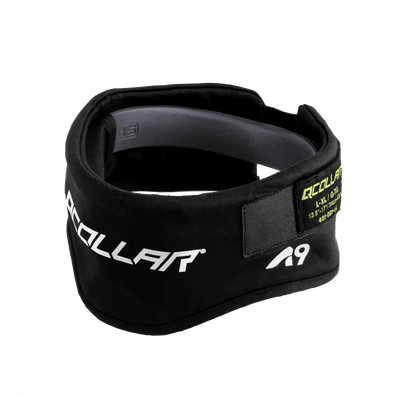
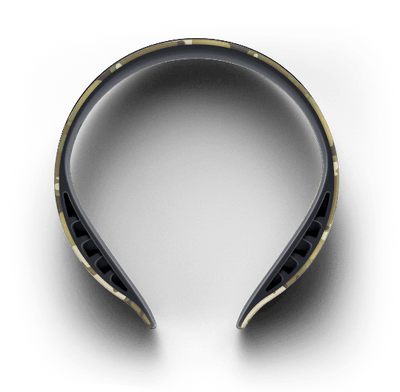
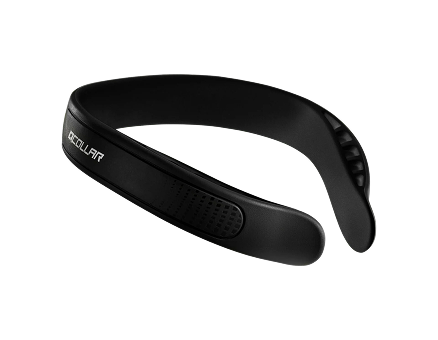
The Q-Collar was developed specifically in the context of that bounded role. It's a horseshoe-shaped neck band that is FDA-cleared to aid in the protection of the brain from effects associated with repetitive sub-concussive head impacts. It works through a completely different mechanism than a helmet: by applying gentle pressure to the jugular veins, the Q-Collar slightly increases blood volume inside the skull, which helps reduce the brain's movement during impact. You can read the mechanism explained in detail on the How It Works page and the underlying scientific research Q30 has published.
Critically, the Q-Collar is designed to sit with a helmet, not instead of it:
- It's worn on the neck, below the helmet and above the shoulder pads. It does not interfere with the F7's fit or function.
- It addresses a different variable than the helmet does. A helmet manages external force. The Q-Collar addresses internal brain movement. The two work on different physics, so stacking them is additive rather than redundant.
- Clinical trials have found no negative effect on athletic performance, no impact on strength, balance, blood oxygen levels, or endurance.
- It's worn across the NFL, NHL, NLL, and at college and high school levels, often in combination with top-rated helmets exactly like the F7.
A player wearing an F7 plus a Q-Collar is running the highest-performing modern helmet technology on the outside of the skull and a device engineered specifically to reduce brain movement on the inside. That's a layered stack. That's what the current research literature argues for, not one piece of equipment doing everything, but a thoughtful system of complementary layers working together.
A Complete Game-Day Protection Stack
If you're building out a high-performance football protection setup for the 2026 season, here's what the most thoughtful stack looks like:
- Helmet: A 5-star Virginia Tech-rated helmet, professionally fitted. The F7 family sits firmly in this tier, with options for every budget and age level.
- Facemask: Position-appropriate facemask, recertified annually along with the helmet.
- Shoulder pads: Properly sized for the athlete's position. Good pads don't create leverage points that transfer force to the head.
- Mouthguard: Fitted, not generic. Primary role is to protect the teeth from fractures and knock-outs.
- Q-Collar: An additional FDA-cleared layer engineered specifically for brain movement. Works alongside, not in place of, the helmet.
- Exposure management: Equipment is only one layer. Reduce unnecessary contact in practice, limit live-tackling reps, and teach heads-up technique. All the research supports it.
FOR ATHLETES
Q-Collar
Proven to help protect athletes' brains in a way other equipment can't.
$199.00
Buy NowFrequently Asked Questions
Is the Schutt F7 a good helmet?
Yes. The F7 line is consistently top-rated in the Virginia Tech STAR ratings, with 5-star designations across multiple variants. It's a well-engineered modern helmet with specific design features aimed at managing rotational forces, a focus that aligns with contemporary concussion biomechanics research.
What's the difference between F7 Pro, F7 Air, and F7 2.0?
The F7 Pro is the flagship, 3D-printed lattice interior, titanium facemask, highest-end fit system, and the highest price. The F7 2.0 is the previous-generation flagship, still in production, still 5-star rated, and an excellent value. The F7 Air is the accessible entry to the F7 platform, available in both varsity and youth sizing with a carbon steel facemask. The F7 LX1 is built specifically for youth football.
How much does the Schutt F7 cost?
The F7 Pro retails at approximately $1,499. The F7 2.0 and F7 Air variants are priced below that, often in the $500–$900 range depending on retailer, youth vs varsity, and facemask options. The youth F7 LX1 is typically the most accessible entry point. Check the official Schutt F7 collection for current pricing.
Does a 5-star Virginia Tech rating mean a helmet prevents concussions?
No. The Virginia Tech STAR rating is a standardized lab measure of impact performance on a test headform. A 5-star helmet performs significantly better than average in that test battery, which is a meaningful data point. It does not guarantee the wearer will never experience a concussion, and no helmet on the market prevents concussions. VT explicitly states as much on their website.
Can I wear a Q-Collar with a Schutt F7 helmet?
Yes. The Q-Collar is designed to sit on the neck below the helmet and above the shoulder pads. It does not interfere with helmet fit or function. Many athletes, including pros across the NFL and college athletes using F7-tier helmets, wear the Q-Collar alongside their helmet for a layered protection approach.
Does the Q-Collar replace the need for a good helmet?
No. The Q-Collar is designed to be used in addition to a helmet, shoulder pads, and other sport-appropriate protective equipment, not in place of them. A helmet manages external impact forces; the Q-Collar addresses internal brain movement. They target different variables, which is why the layered approach makes sense.
How do I decide between the F7 and other top-rated helmets?
Fit is often the deciding factor. Two helmets can have identical VT ratings but perform differently for a given athlete based on head shape. If possible, try the F7 alongside other 5-star options (from Riddell, Vicis, Xenith, etc.), prioritize a professional fitting, and let comfort and stability drive the final decision. Then build out the rest of your protection stack from there.
Powered by BloggedAi · Founding Engine