

Head Impacts in Football: The Science of Brain Slosh Explained
Summary
- Head impact in football involves multiple types of force acting at the same time. Linear acceleration, rotational acceleration, and the resulting movement of the brain inside the skull are all part of the mechanical chain.
- "Brain slosh" describes the movement of the brain inside the skull during impact. The brain is soft tissue suspended in cerebrospinal fluid, which fills the space around it. When the head accelerates suddenly, the brain has its own momentum and continues moving until it meets the inside of the skull.
- Sub-concussive impacts, hits that do not produce diagnosable concussion symptoms, still transfer force to the brain. Research has documented cumulative effects across a single season of contact-sport participation.
- Diffusion tensor imaging (DTI) has allowed researchers to detect micro-structural changes in brain tissue that standard MRI cannot see. Peer-reviewed studies have used DTI to measure season-long changes in football players.
- Authoritative resources on head impact in sport include the CDC HEADS UP program, the American Academy of Pediatrics, and the Boston University CTE Center.
- The Q-Collar is the only FDA-cleared device designed to help protect the brain from effects of repetitive sub-concussive head impacts. In peer-reviewed clinical research, scientists observed that athletes who wore the Q-Collar showed no significant changes in brain white matter over a season of play on DTI imaging, while athletes who did not wear it showed significant changes.
Jump to a Section
- The Two Kinds of Force at Play in a Football Hit
- Linear vs. Rotational Acceleration
- The Brain Inside the Skull: How Slosh Happens
- Sub-Concussive Impacts: The Hits That Do Not Get Diagnosed
- What DTI Imaging Has Taught Us
- Cumulative Exposure Across a Season
- Where Equipment Fits in the Mechanical Chain
- Frequently Asked Questions
The Two Kinds of Force at Play in a Football Hit
Every football play that involves head contact involves the same general physics. A helmet meets another object, often another helmet, often at high speed. Force is transferred. The head moves. The brain inside the head experiences that movement in its own way.
The mistake many readers make, and the one football safety conversations often perpetuate, is treating "a hit" as a single event with a single force. It is not. A football impact involves at minimum two distinct categories of force, often acting in the same instant. Understanding the difference is the foundation for understanding everything else about head injury in the sport.
The first category is external force on the skull. This is what helmets are engineered to address. A direct blow to the front, side, or back of the head transmits energy through the helmet shell into the bone of the cranium. The helmet's job is to absorb, distribute, and slow that energy so that the bone is not fractured and the force reaching the head is reduced.
The second category is internal force on the brain. This is what happens after the helmet does its job. The head, with the helmet on it, accelerates or decelerates suddenly. The brain, with its own mass, continues moving according to its own momentum. The two are not the same object, and they do not move together.
This second category is where the science of brain slosh lives.
Linear vs. Rotational Acceleration
Within the category of force acting on the head, biomechanics researchers distinguish between two patterns of motion. Both matter. They affect the brain in different ways.
Linear acceleration is a straight-line change in head velocity. A direct front-to-back hit, a head striking the ground after a tackle, a helmet-to-helmet collision in line play. The head moves along an axis, decelerating or accelerating in a roughly straight direction.
Rotational acceleration is a twisting motion. The head rotates around an axis, often the neck. A side-arm tackle that catches the helmet at an angle, a spinning fall, an impact that strikes the helmet off-center. The head turns rather than translating in a line.
Both kinds of acceleration produce force on the brain, but research has consistently associated rotational forces with a higher risk of certain types of brain injury. The reason is in the tissue itself. The brain's white matter, which carries the signal connections between brain regions, runs in long axonal fibers. Rotational forces shear those fibers. Linear forces compress and stretch them, but rotation does damage in a different mechanical way.
This distinction matters for how the safety conversation has evolved. Early helmet design focused on linear impact, because that is the most intuitive way to think about a hit. The current generation of helmet engineering also considers rotational forces, with various technologies aiming to allow the helmet shell to absorb some rotational energy before it reaches the head. These designs help, but they do not eliminate the underlying physics.
The Brain Inside the Skull: How Slosh Happens
Here is the part that does not show up in most football safety conversations until someone explains it directly. The brain is not bolted in place. It is soft tissue, the consistency of firm gelatin, suspended in cerebrospinal fluid. There is space filled with CSF, called the subarachnoid space, between the brain and the inner wall of the skull.
This setup serves a normal protective function under normal conditions. The fluid cushions the brain against everyday motion. But under the high-acceleration conditions of a football hit, the same setup becomes a problem. The skull stops or changes direction. The brain, with its own mass and momentum, keeps moving. It travels through the fluid and meets the inside of the skull.
This is brain slosh. The brain moves linearly, rotationally, or both, depending on the type of impact. It strikes the inside of the skull. It often rebounds and strikes the opposite side. The result is mechanical stress on brain tissue, including the white matter, that no helmet is designed to prevent because no helmet operates inside the skull.
The clinical relevance of this internal movement has driven a substantial body of research over the last two decades. The mechanical concept is sometimes referred to as "slosh" because the dynamics resemble a partially-filled container of fluid being shaken. Increasing the blood volume inside the skull so the brain fits more snugly and moves less is one mechanism researchers have explored as a way to help protect against the effects.
Sub-Concussive Impacts: The Hits That Do Not Get Diagnosed
For most of football's history, the head-injury conversation focused on diagnosable concussions. A player took a hard hit, showed symptoms, was evaluated, and either returned to play or sat out. The hits that did not produce visible symptoms were generally treated as not-a-concern.
The science has changed. A sub-concussive impact is a head impact that transfers measurable force to the brain but does not produce diagnosable concussion symptoms. These hits accumulate. A single play has multiple sub-concussive impacts across the players involved. A practice has many. A season has thousands. Research suggests that this cumulative load matters, even when no single impact crosses the symptomatic concussion threshold.
This shift in understanding is reflected in resources like the CDC HEADS UP program, which now emphasizes cumulative head impact exposure as an area parents, coaches, and athletes should understand. The shift is also reflected in the research priorities of major institutions, including the Boston University CTE Center, which has documented post-mortem evidence of chronic traumatic encephalopathy in former football players.
The implication for active players is straightforward. The hits that do not produce a concussion diagnosis are not the same as no impact. They register. They accumulate. They matter.
What DTI Imaging Has Taught Us
Standard MRI is good at showing structural damage to the brain. It is not sensitive enough to detect the kind of micro-structural changes that accumulate from repeated sub-concussive impacts. Researchers needed a different tool.
Diffusion tensor imaging, or DTI, fills that gap. DTI measures the diffusion of water molecules in brain tissue. Because water diffuses differently in healthy versus damaged white matter, DTI can detect changes that are invisible to standard imaging. It does not require a clinical concussion event. It can measure subtle changes across a population of athletes participating in normal play.
DTI is the technique that has allowed researchers to document the cumulative effects of sub-concussive impacts across a single season. The British Journal of Sports Medicine and other peer-reviewed journals have published DTI-based studies on high school, college, and professional football players. The general pattern across this body of research is consistent. White matter integrity, as measured by DTI biomarkers, changes across a season of contact-sport participation.
This is the imaging technique that produced the Q-Collar's most cited statistic. In peer-reviewed clinical studies of football players, researchers observed that athletes who wore the Q-Collar showed no significant changes in brain white matter over a season of play on DTI imaging, while athletes who did not wear it showed significant changes despite similar head-impact exposure. For a wider read of what a decade of this kind of research has surfaced, see a decade of sub-concussive impact research.
Cumulative Exposure Across a Season
Individual impacts matter. Cumulative exposure matters more. The number of head impacts a football player experiences across a season varies significantly by position, by level of play, and by amount of contact practice the team runs.
Research has used helmet sensors to count and characterize the impacts a player experiences in a typical season. The numbers can be striking. Positions with the highest exposure, including offensive and defensive linemen and linebackers, can experience hundreds to over a thousand recorded head impacts in a single season of high school or college play. Lower-exposure positions still register significant counts.
For an analysis of how head impact exposure changes from youth through professional levels, see one sport, three exposure curves. For broader parent-facing context on what this means for younger athletes, the American Academy of Pediatrics provides guidance on sport-related concussion. Additional context on youth safety is covered in youth sports brain safety: what parents need to know in 2026.
The mechanical story is the same regardless of level. Each impact transfers force to the brain. Each adds to the cumulative load. The research community now treats this exposure profile as a critical variable in understanding long-term brain health outcomes.
Where Equipment Fits in the Mechanical Chain
Knowing the science is one thing. Translating it into equipment decisions is another. The football protection ecosystem is built around the layered mechanical chain that produces brain impact effects. Different categories of equipment address different links in the chain.
Helmets address the external impact. They absorb and distribute the force of the hit before it reaches the skull. Modern helmet design also accounts for rotational forces. A well-fitted, current-generation helmet is essential foundational equipment.
External padding additions, such as Guardian Caps, add another absorption layer at the point of contact. They are an upstream intervention in the same chain that the helmet itself addresses.
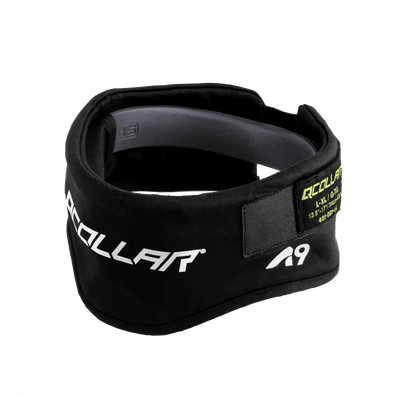
Neck collars and cowboy collars address the cervical spine. They are designed to help reduce stinger injuries and hyperextension. They do not address brain movement inside the skull, because that movement happens above the structure they are designed to protect.
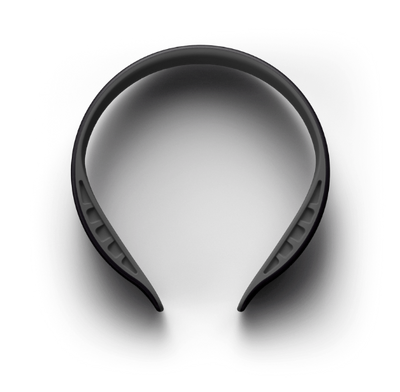
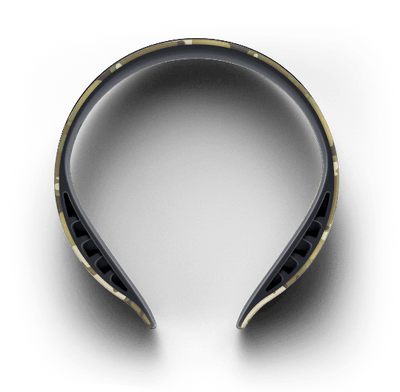
The Q-Collar sits at a different link in the chain. It is the only FDA-cleared device in its category. By applying light, comfortable pressure to the sides of the neck, it partially occludes the jugular veins and slightly increases the blood volume inside the skull. With more blood volume, the brain fits more snugly within the skull cavity and moves less during impact — and it does this without reducing blood flow through the carotid arteries. The mechanism is a direct response to the brain slosh problem described above. For a side-by-side breakdown of how the Q-Collar relates to other football protection, see Q-Collar vs. Guardian Caps vs. helmets and the safest football helmet isn't enough.
None of these devices replaces any other. Each one addresses a different part of the mechanical chain. Together they cover more of the chain than any single piece of equipment alone.
The science of brain slosh is not abstract. It is a physical event that happens inside the skull of a football player on every meaningful impact. Understanding it is the foundation for any informed conversation about what protection options actually do, and what part of the problem still needs to be addressed.
For families building a complete football safety setup, the Q-Collar product page covers pricing, sizing, and the full feature set, and the deeper sport-specific research is gathered on the Q-Collar in football page.
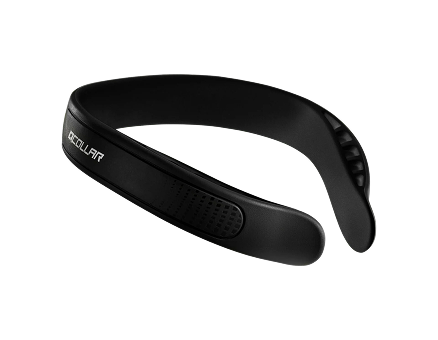
FOR ATHLETES
Q-Collar
The first and only FDA-cleared device designed to help protect the brain from the effects of repetitive sub-concussive head impacts in sports.
$199.00
Buy NowFrequently Asked Questions
What is brain slosh?
Brain slosh refers to the movement of the brain inside the skull during a head impact. The brain is soft tissue suspended in cerebrospinal fluid, which fills the space around it. When the head accelerates, decelerates, or rotates suddenly, the brain continues moving and can strike the inside of the skull. This internal motion is one of the mechanical drivers of brain injury.
What is a sub-concussive impact?
A sub-concussive impact is a head impact that does not produce diagnosable concussion symptoms but still transfers force to the brain. Research suggests that repeated sub-concussive impacts can accumulate measurable changes in brain tissue over time, even without any single hit producing a concussion diagnosis.
How is repetitive head impact damage measured?
Diffusion tensor imaging, or DTI, is a brain-imaging technique that detects micro-structural changes in brain tissue that standard MRI cannot see. Researchers have used DTI in clinical studies to document changes associated with a season of football and other contact sports.
What is the difference between linear and rotational acceleration?
Linear acceleration describes a straight-line change in head velocity, such as a direct front-to-back impact. Rotational acceleration describes a twisting change in head motion. Rotational forces are particularly associated with brain injury because they create shearing stress on brain tissue.
Do helmets stop brain slosh?
Helmets are designed to help reduce skull fracture and the peak force of external impact. They are not designed to address brain movement inside the skull. Brain slosh happens on the other side of the bone the helmet protects.
What can be done about brain slosh?
The Q-Collar is an FDA-cleared Class II medical device designed to help reduce the internal movement of the brain inside the skull during head impacts. It applies light, comfortable pressure to the sides of the neck, partially occluding the jugular veins. This slightly increases blood volume inside the skull, so the brain fits more snugly and moves less during impact.
What does the research say about the Q-Collar?
In peer-reviewed clinical studies, researchers observed that athletes who wore the Q-Collar showed no significant changes in brain white matter over a season of play on DTI imaging, while athletes who did not wear it showed significant changes. The Q-Collar is the only FDA-cleared device in its category. See the published research.